One district.
One high school.
One path forward.
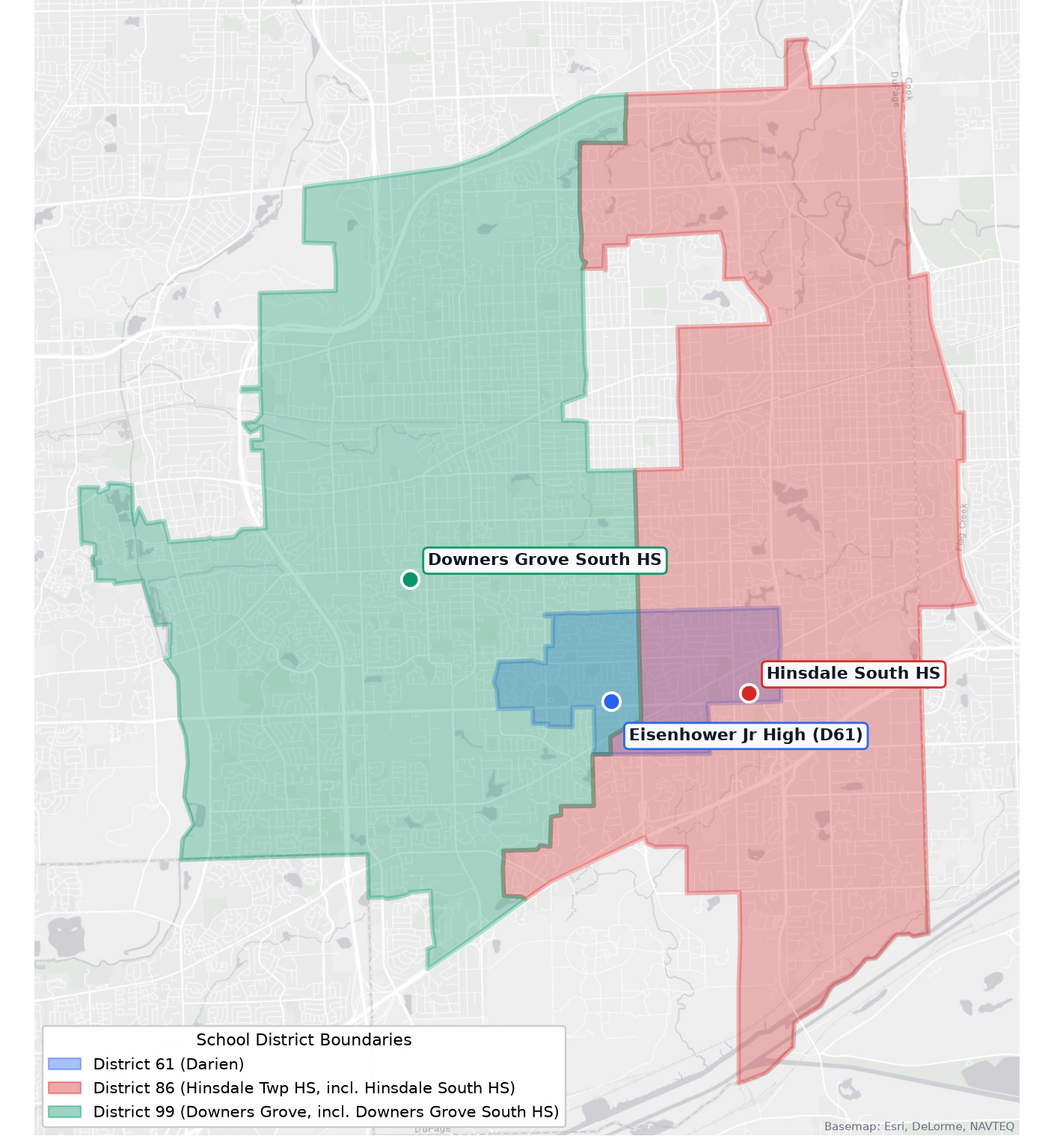
District 61 splits its own graduates after 8th grade — some to Hinsdale South, some to Downers Grove South — based only on which side of Cass Avenue they live on. We're organizing to change that.
An independent resident effort — not affiliated with, or endorsed by, District 61, District 86, District 99, or the City of Darien.
Cass Avenue splits kids who grew up together
Every Darien D61 student attends the same K-8 schools together. Then, at the exact same address line, the district hands them two different high school futures.
Using both districts' own official boundary tools, the dividing line runs almost entirely along Cass Avenue, jogging west near Plainfield Road and continuing south past Bailey Road. East of Cass Avenue feeds Hinsdale South (District 86); west of Cass Avenue feeds Downers Grove South (District 99) — even though both sides are inside the same D61 boundary and the same Eisenhower Junior High building (myrealtortati.com; Wikipedia).
This isn't hypothetical. In August 2026, Darien resident Lisa Schmidt told the City Council that Hinsdale South is less than a mile from her home, yet her children are assigned to Downers Grove South — nearly three times farther. Neighbor Dave Isaacson circulated a petition that gathered 19 signatures asking the City to look into it (Patch.com).
Example — a home on Grant Street, inside the affected area, is a roughly 4-minute drive (1.47 mi) from Hinsdale South, but is assigned to Downers Grove South, a roughly 10-minute drive (4.17 mi) away.
This split is older than most of us realized
Eisenhower Junior High opened in 1969 — and the Cass Avenue dividing line predates even that. This isn't a new problem; it's a decades-old one that's never been fixed.
Cass Avenue was already the line — with one carve-out
Before Eisenhower even existed, Darien kids west of Cass Avenue were zoned to Downers Grove South. One small pocket south of Plainfield Road was the exception: a local doctor circulated petitions so his own children could attend Hinsdale South instead, carving that pocket out of an otherwise all-Downers Grove area (Darien oral history archive, IPPL).
Eisenhower Junior High opens
Named for President Dwight D. Eisenhower, who died that same year. A former D61 resident recalled her older daughter finishing 8th grade at the old Lace Marion School just before Eisenhower was built, with her son in Eisenhower's first graduating class (Historypin; IPPL oral history).
The boundary kept moving
District records show a string of boundary adjustments touching this area — a 1977 Cass Boundary Petition, a 1983 Cass School Boundary Change, and a 1986 Darien School Boundary Change — the likely path by which the small 1960s Hinsdale South carve-out grew into a much larger share of D61 (Hinsdale Township HSD 86 boundary history).
A parents' group already tried to fix this — and it didn't happen
D61's own superintendent told the District 86 board the split had reached roughly 60% Hinsdale South / 40% Downers Grove South, depending on which side of Cass Avenue a family lived on. A District 61 parents' group asked District 86 to accept all Eisenhower graduates — potentially 400 more students at Hinsdale South. The board's minutes note the ask but never record it succeeding (Hinsdale Township HSD 86 board minutes, Dec. 17 1990).
Today: a "roughly equal" split, and a new push to end it
District 61 now describes the split as roughly even between the two high schools. Thirty-six years after the last documented attempt failed, residents are organizing again — this time as a standing committee, not just a one-time petition (Patch, Aug. 2026).
This timeline is built from primary and local-history sources: Historypin — Eisenhower Junior High School, IPPL Darien oral history transcript, Hinsdale Township HSD 86 buffer-zone boundary history (2016), and Patch reporting, August 2026. Some early dates (e.g., the exact year the original carve-out began) aren't precisely documented in public records — where sources are approximate, we've said so.
This isn't about which school is "better"
Both high schools carry the same state quality designation. The real differences are distance, safety, and how efficiently tax dollars reach the classroom — not academic outcomes.
| Metric | Hinsdale South (D86) | Downers Grove South (D99) |
|---|---|---|
| Enrollment | 1,324 students | 2,551 students |
| State summative designation | Commendable School | Commendable School |
| 4-year graduation rate | 89.7% (class of 2025) | 90% (class of 2025) |
| Per-pupil spending | ≈ $32,000 / student | ≈ $24,000 / student |
| Student-teacher ratio | 13 : 1 | 14–15 : 1 |
| National / state ranking | #1,450 nat'l · #66 in IL | #75 best public HS in IL (Niche) |
| Distance — example Grant St. home | 1.47 mi (4 min) | 4.17 mi (10 min) |
Sources: Illinois Report Card — Hinsdale South, Illinois Report Card — Downers Grove South, Niche — Hinsdale South, Niche — Downers Grove South, US News rankings. Both schools currently carry the same "Commendable" designation and near-identical graduation rates — the real gap is per-pupil spending and distance, not academic quality.
Every street already qualifies for busing
All 88 affected streets exceed the 1.5-mile threshold both districts use to provide mandatory bus service (CSD 99, Hinsdale South) — the question is only how much longer that ride has to be.
The assigned route runs a busier road
The direct route to Downers Grove South uses a 4-5 lane, 40-mph arterial with no recorded sidewalks and a documented hit-and-run crash at 63rd & Dunham (Patch). The route to Hinsdale South stays on local Darien streets.
26-minute bus ride, on average — vs. an estimated 2–11
Households sit 65% farther by drive time from their assigned school. Matched against CSD 99's actual 2024-25 AM bus schedule, that's a real pickup-to-arrival ride averaging 26 minutes (up to 40 on some streets) — versus an estimated 2–11 minute ride if these streets were added to an existing Hinsdale South route nearby.
Enrollment size is already shaping what Hinsdale South can offer
Eisenhower's roughly 120-160 8th graders each year currently split between two high schools that are moving in opposite directions — Downers Grove South is more than double Hinsdale South's size and holding steady, while Hinsdale South has been shrinking for years. That gap is not abstract: District 86's own leadership has tied it directly to which courses and programs the school can afford to run.
| Metric | Eisenhower Jr High (8th grade) | Hinsdale South (D86) | Downers Grove South (D99) |
|---|---|---|---|
| Current enrollment | 122 students (386 total, grades 6–8) — approximately 120–160, varying by year and source | ~1,205–1,370 (1,303 official Oct. 2025 count) | ~2,535–2,604 |
| 5–10 year trend | Varies year to year | Declining — down ~19% since 2018 | Roughly flat / slight decline |
| Relative size | — | About half of Downers Grove South | Roughly double Hinsdale South |
Sources: District 61 live enrollment dashboard (embedded via BoardBook board agendas); third-party sites report a higher 8th-grade figure for an earlier year (U.S. News, Illinois Schools Hub) — hence "approximately 120–160, varying by year and source." Hinsdale South enrollment: HTHSD 86 FY2026 Annual Budget Report, Hinsdale South School Profile 2026-27; trend also confirmed by National Today, March 2026 and the district's own 2023 Kasarda demography report. Downers Grove South enrollment: DuPage Policy Journal, citing ISBE data, CSD 99 DGS School Profile.
Orchestra isn't offered at Hinsdale South
Hinsdale South has not run its own orchestra program this school year or last. Students who want orchestra have to be driven by a parent to Hinsdale Central for the class — the district provides no transportation for it — and because it happens during the school day, that commute costs them instructional time in their other courses. District administration moved to formally eliminate South's orchestra courses starting in fall 2025, and by the most recent board reporting the program was described as already "going away," with no district-run shuttle or transportation fix yet in place (Patch, Sept. 2025; Patch, Oct. 2025; Patch, Nov. 2025; Patch, March 2026).
Central offers 44 courses South doesn't
District 86's own materials, presented at the Sept. 25, 2025 board meeting, show 44 courses running at Hinsdale Central but not Hinsdale South, versus only 10 the other way. Music is the single largest gap — 28 courses at Central versus 17 at South. AP Music Theory is one example: it's in the catalog at both schools on paper, but board members have acknowledged the actual campus it runs at shifts year to year based on where enrollment clears the threshold, and in the most recent staffing cycle it ran at Central, not South, with no independent-study option for South students who wanted it (Patch, Jan. 2025; Patch, Sept. 2025; Patch, Sept. 2025).
A superintendent flagged this in 2023
At an April 2023 board meeting, Superintendent Tammy Prentiss told the board that low enrollment at South had already caused some courses to go unoffered, and warned the list would grow as enrollment kept declining — while discussing attendance-boundary changes as a possible remedy. The pattern she predicted is exactly what's now playing out with the orchestra cut (The Hinsdalean, May 2023).
One nuance worth being upfront about: Hinsdale South actually offers more foreign-language tracks than Downers Grove South (French, German, Latin, Spanish, and ASL — five — versus French, German, and Spanish at Downers Grove South), so language breadth isn't where the disparity shows up. Music is where it shows up: orchestra is gone from South's own campus, and AP Music Theory — while listed in the catalog — is subject to the same low-enrollment cancellations, with no independent-study alternative offered to South students either way. We'd rather present this accurately than overstate the case.
Sources: Hinsdale HSD 86 Program of Studies, 2025-26; CSD 99 World Languages; The Hinsdalean, Nov. 2025 (AP Music Theory assigned to Central).The tax math cuts both ways — and near-term, it favors moving forward
We built a 4-year cost model to answer the obvious follow-up question: what would this actually cost or save each district? It phases in an estimated 73 students/year (292 at full steady state, using Eisenhower's 8th-grade enrollment and the territory's ~46% share of D61) and looks at the property-tax revenue shift alongside two different ways of counting operating cost.
| Year | D99 net | D86 net | System-wide net |
|---|---|---|---|
| Year 1 (~73 students) | –$1,270,000 | +$1,079,000 | –$191,000 |
| Year 2 (~146 students) | –$2,591,000 | +$2,209,000 | –$382,000 |
| Year 3 (~219 students) | –$3,911,000 | +$3,338,000 | –$573,000 |
| Year 4 (~292 students, full) | –$5,232,000 | +$4,467,000 | –$764,000 |
Marginal cost = only the class sections and bus routes actually added or avoided (both schools currently run at roughly 75% of stated capacity, so no new construction is triggered on either side). The system-wide loss is driven by the tax-rate gap itself — D99's rate is higher than D86's, so the same taxable value generates less revenue after the shift than before it. Figures are model estimates, not official district numbers. Sources: CHSD 99 FY2025 ACFR, D86 FY2024 ACFR, Illinois Report Card.
There's a second, opposite-reading way to count cost. If each district's full ACFR-reported average cost per pupil moved with the student — rather than just the marginal sections and bus routes — the story flips: by Year 4, D99 would show a net gain of roughly +$4.0M (the "saved" average cost outweighs its tax loss) and D86 would show a net loss of roughly –$4.0M. We think the marginal-cost view above is the more realistic near-term budget picture, precisely because neither school needs new capacity yet — but we're presenting both lenses rather than picking the one that tells the better story.
What this means for an individual homeowner's tax bill
The district-level numbers above are budget totals — millions of dollars moving between two school systems. But the question homeowners actually ask is simpler: would my tax bill go up? For the average parcel in the moving territory, the answer is no — it goes down, because D86's tax rate is lower than D99's.
| Year | School tax if still D99 | School tax if now D86 | Annual savings |
|---|---|---|---|
| Year 1 (phased-in) | $2,342 | $2,030 | ≈$78 |
| Year 2 (phased-in) | $2,342 | $2,030 | ≈$156 |
| Year 3 (phased-in) | $2,342 | $2,030 | ≈$234 |
| Year 4 (full / steady state) | $2,342 | $2,030 | ≈$312 (~13%) |
"Phased-in" years follow the same 25/50/75/100% timing convention used for the student-cohort model above, as an internal consistency check — the actual legal mechanism for a Regional Board boundary order is typically a single effective date, in which case a territory homeowner would see the full ≈$312/year reduction starting Year 1. Either way, both timings converge to the same steady-state savings. Figures are model estimates based on 2,448 parcels and DuPage County Clerk 2025 tax rates, not an official district or county calculation.
Important distinction: this is a story about the moving territory, not about tax rates district-wide. Under Illinois's Property Tax Extension Limitation Law (PTELL), when territory is disconnected from one district and annexed to another, each district's total tax extension (the dollar amount it's allowed to collect) is adjusted to remove or add that territory's EAV — but the tax rate applied to everyone else's property is designed to hold roughly flat. In plain terms: homeowners who already live in D99 territory that isn't moving, and homeowners already in D86, shouldn't see their own school-tax rate change because of this realignment. The people who see a real change are the roughly 2,448 households whose parcels actually cross from D99 into D86 — and for them, it's a decrease. Source: Illinois Dept. of Revenue, PTELL Technical Manual (PTAX-1080); IDOR PIO-62, Overview of PTELL by Referendum.
Could families already enrolled at D99 choose to move to D86 instead of everyone shifting at once? Possibly — but it would take a negotiated agreement, not an automatic right. Illinois law doesn't build family choice into the general boundary-change process, but two narrower parts of the same School Code already use this exact idea elsewhere: a family whose child is already attending the district losing territory can elect to keep that child enrolled there, with the district gaining the territory paying per-pupil tuition to cover it. We think a similar time-limited, one-choice-per-family election window — funded the same way — is a reasonable term to propose at the D99/D86 negotiating table alongside the revenue-bridge idea above, not something to expect a Regional Board order to grant on its own.
Neither school needs a new wing
Even at full steady state, D99 falls to roughly 2,266 students against a stated 3,400 capacity, and D86 rises to roughly 1,595 against a stated 1,705 capacity — both still under their own ceilings. That's the main reason the marginal-cost lens produces such a modest number: this is a staffing and busing adjustment, not a construction project.
The tax-rate gap is the real driver
D99's county tax rate (1.80%) is higher than D86's (1.56%) on the same territory value, so shifting the tax base from one to the other doesn't net to zero system-wide — it's a modest net loss under the realistic view. That's exactly the kind of gap a multi-year revenue-sharing bridge between the districts could address.
This is a model, not a certainty
The cohort size, per-section costs, and busing costs are all estimates built from public data and the best available proxies — including some figures borrowed from D86 reporting because no D99-specific equivalent was found. Treat these as directionally useful, not as numbers either district would sign off on.
We're building a committee, not a lawsuit
This starts with organized residents, not attorneys. We're building on the informal effort neighbors already raised at City Council — formalizing it into the Darien D61 Unified Feeder Committee.
Chair / spokesperson
Public face of the effort — coordinates with the City Council and both school boards.
Data & research lead
Tracks records requests and keeps the comparison packet current and accurate.
Outreach coordinator
Runs door-knocking, social posts, and block-by-block canvassing west of Cass Ave.
Treasurer
Keeps track of any committee funds, especially if legal costs arise later.
Legal liaison
Main point of contact once the committee retains counsel for the formal petition.
Just want to help?
No role required — sign the interest survey, share it with neighbors, or show up when we ask.
None of these roles need special expertise
Just time, reliability, and a willingness to help move this forward. We've already sent public-records requests to all three districts — the more hands we have now, the better.
- Organizer
- Daniel Burr
- drburr@gmail.com
- Facebook Group
- Join the discussion
- Area
- Darien, IL 60561
Tell us where you stand — it takes two minutes
Before committing to the formal legal process — which requires signatures from two-thirds of registered voters in the specific affected territory — we want an honest read on how many households support this.